

Netflix is down nearly 50%: Are their glory days behind them?


Netflix is now back to where it was trading at during the post Covid peak. Meanwhile, their earnings per share is up 180% over that same period. The stock was arguably very expensive through much of the last decade (often trading above 50x earnings) - had you bought in mid 2018, you would have seen a modest 7% annualized return through today. But now at 22x earnings, today marks the cheapest it’s ever been on a price-to-earnings basis (save for a moment in 2022). It seems like a great time to take a look under the hood.
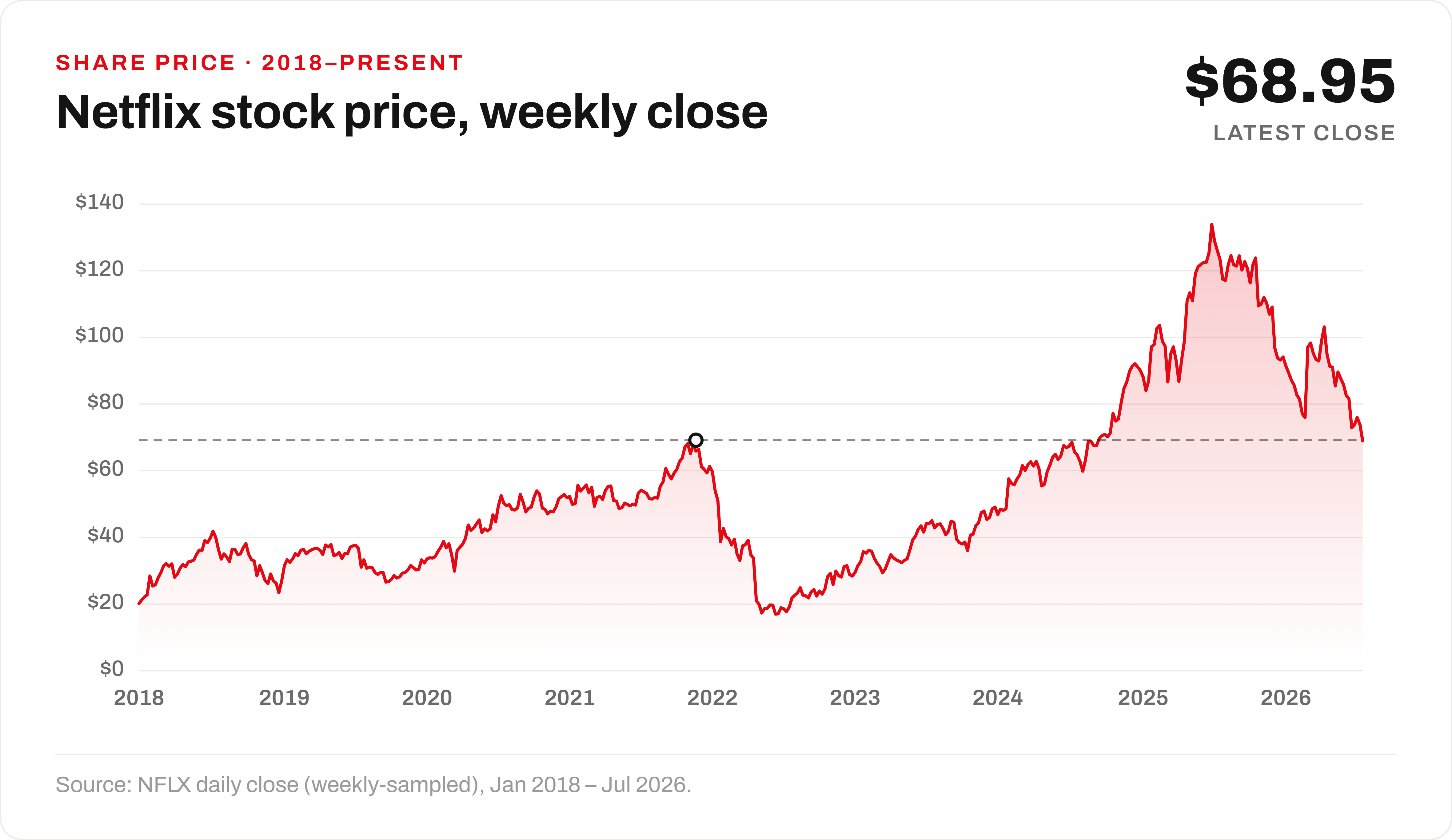
Are Their Glory Days Behind Them?
Since they first introduced the streaming model in 2009, Netflix has had a powerhouse of a growth engine. Growing users and raising prices offers compounding growth of revenues. And being a SaaS model back when it was cool, those incremental revenues largely flowed straight to Netflix’s bottom line.
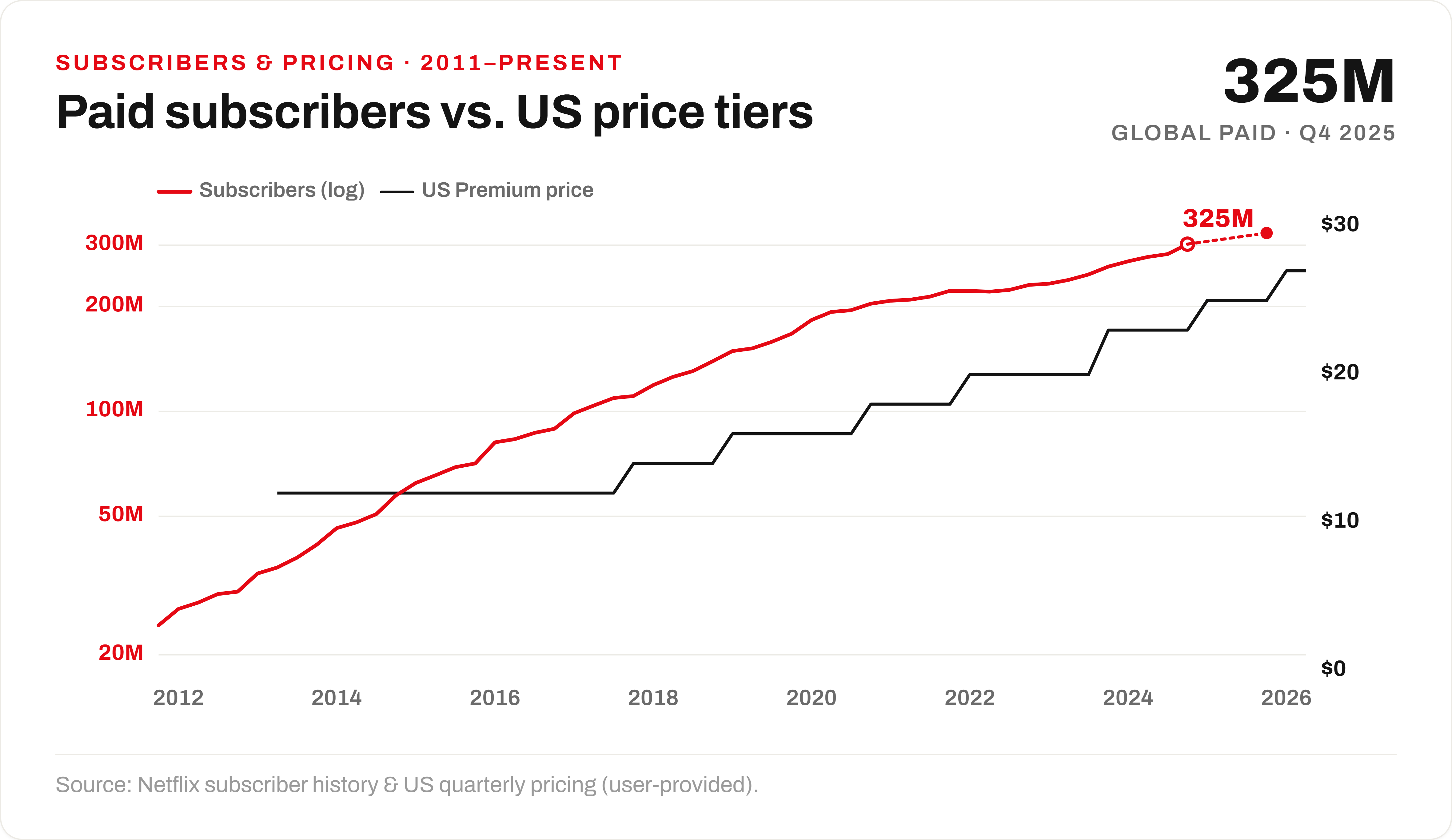
But trees don’t grow to the sky, and their subscriber counts have already started moderating. It’s notable that they’ve stopped even reporting subscriber count metrics in 2024, opting to report only major milestones - like the 325M number in 2025.
The figure below shows year-over-year subscriber growth, which was already seeing a massive deceleration through ‘21 and ‘22. They cracked down on password sharing in 2023, and have experienced a 41% cumulative subscriber bump since then. But that’s a lever you can only pull once.
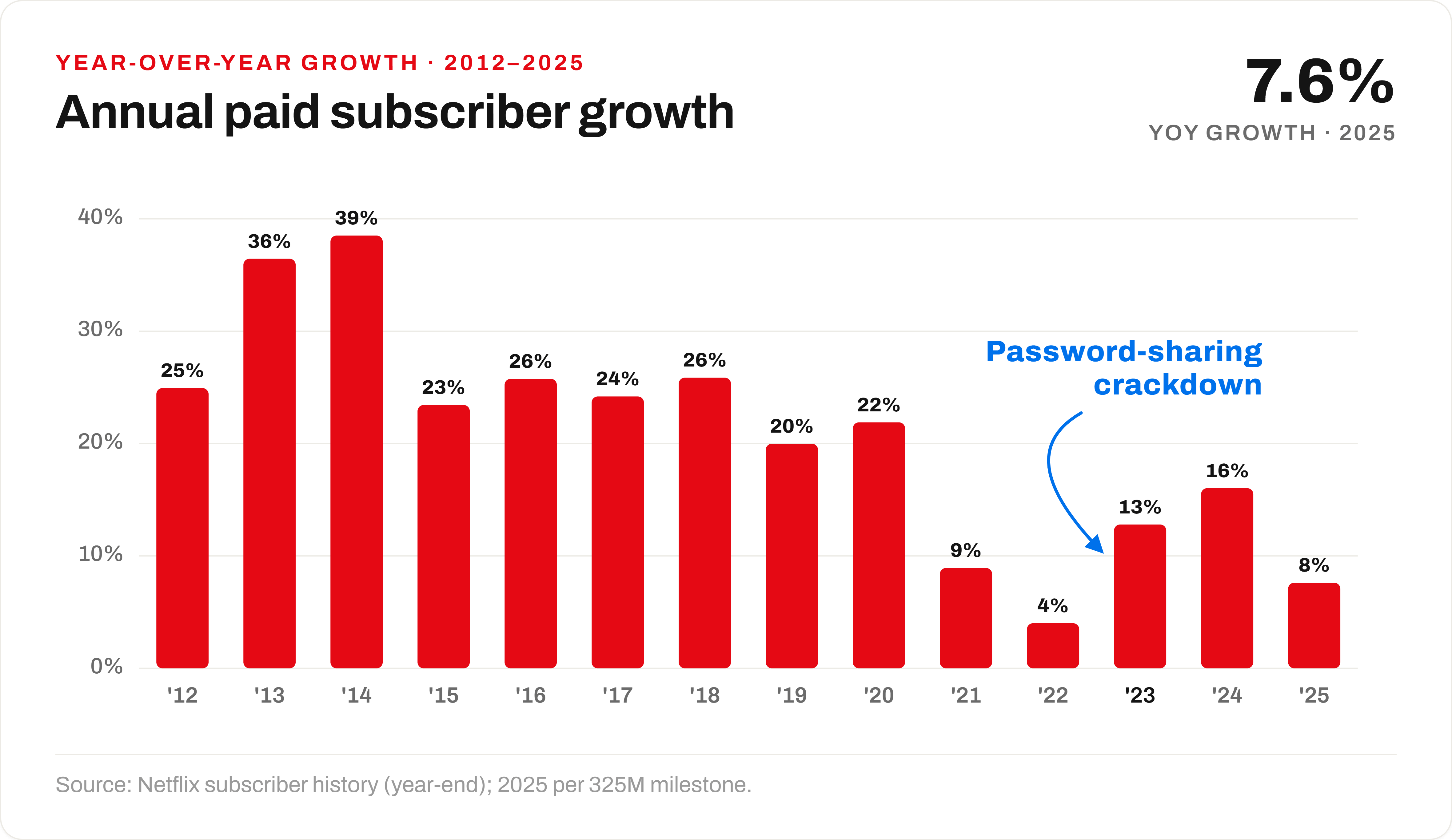
So it wouldn’t be surprising if the majority of future revenue growth has to primarily come from price hikes.
But it’s 26x earnings
While I do think that the glory days are in the rearview, and the once impressive growth engine has started to sputter, that doesn’t mean it can’t be a good value. And that also doesn’t mean it can’t still grow earnings at a high rate…
Note that the 26x PE is normalized to exclude the one-time WBD termination fee.
Three words: Operating Leverage
Operating leverage is the mechanism for which profits can grow faster than revenue. And it all has to do with revenue growth outpacing expense growth (both fixed and variable).
For the math & value nerds
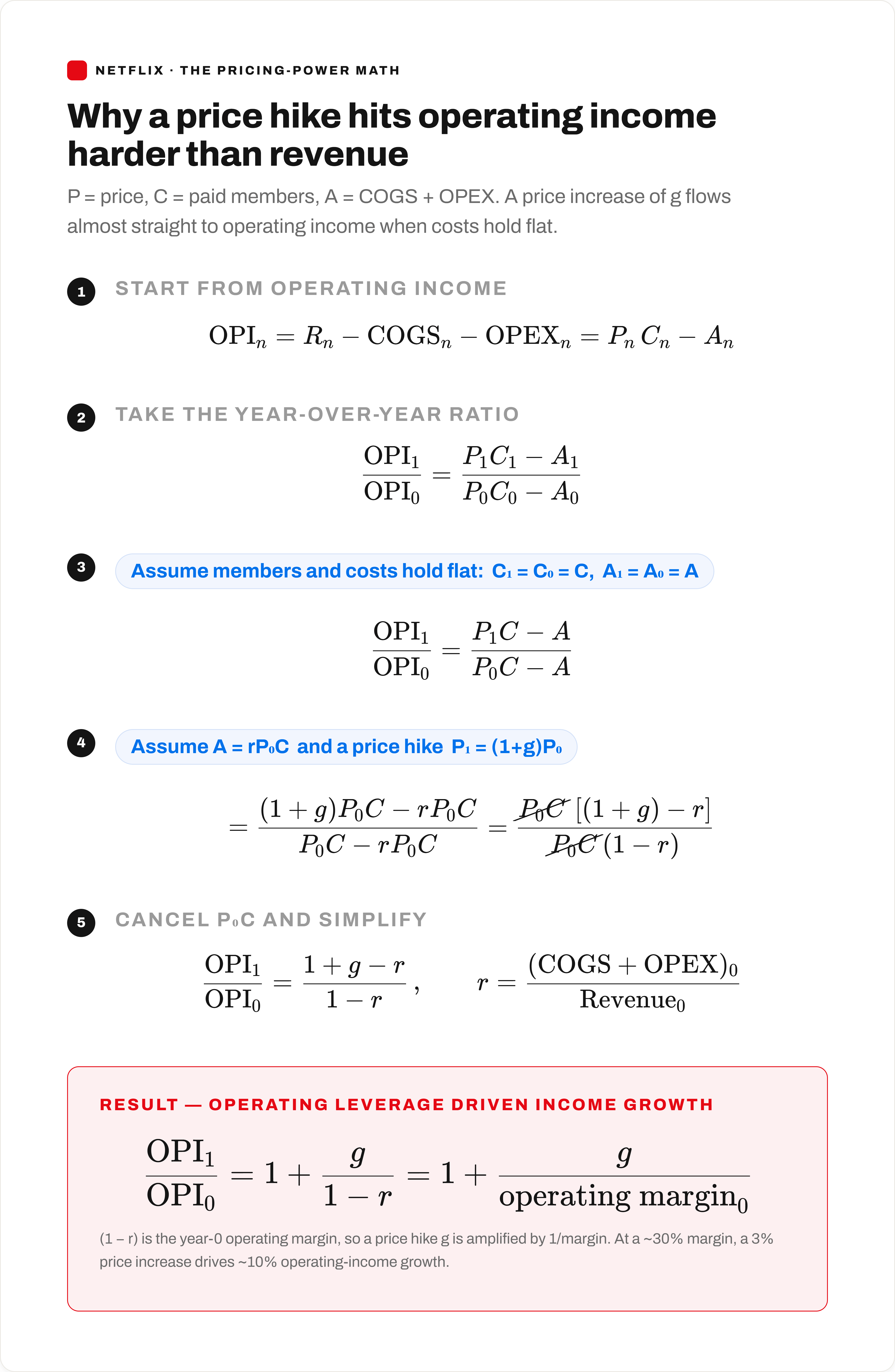
Below is the step-by-step procedure showing how operating leverage can work. In the end, we can see that using Netflix’s current margin profile, a simple 3% subscription price hike can result in a 10% year-over-year increase to profits.
Note, the math below is for illustrative purposes only. It assumes that subscriber counts and fixed & variable expenses are all held constant. These aren’t applicable to Netflix, currently, and I think we can still model in some subscriber growth going forward. This simply highlights that you don’t need 10% revenue growth to see 10% profit growth.
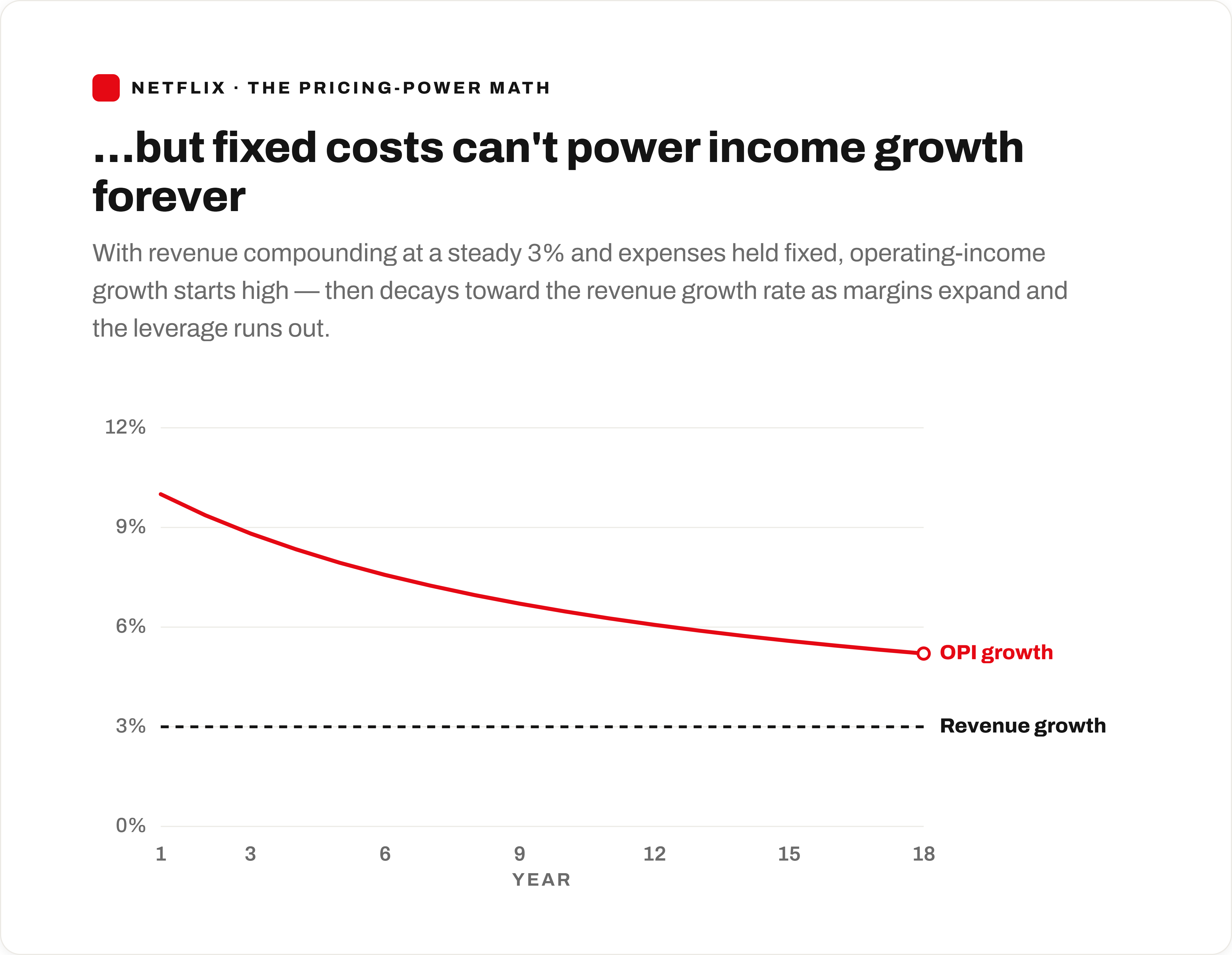
Operating Leverage isn’t perpetual
This dynamic can’t carry the bottom line forever, though. Every year, the operating margin steps up, increasing the denominator, and makes the next incremental jump in income smaller than the last.
Again, this if for illustrative purposes only.
Alright, enough with the value lesson. Let’s dig into some numbers.
Valuation
Business Economics
If we want to forecast future cash flows, we need to get a handle on the overall business. The figure below shows the 2025 income statement breakdown. We see that cost of revenue is a massive component of overall expenses, so we’ll spend some time inspecting those further.
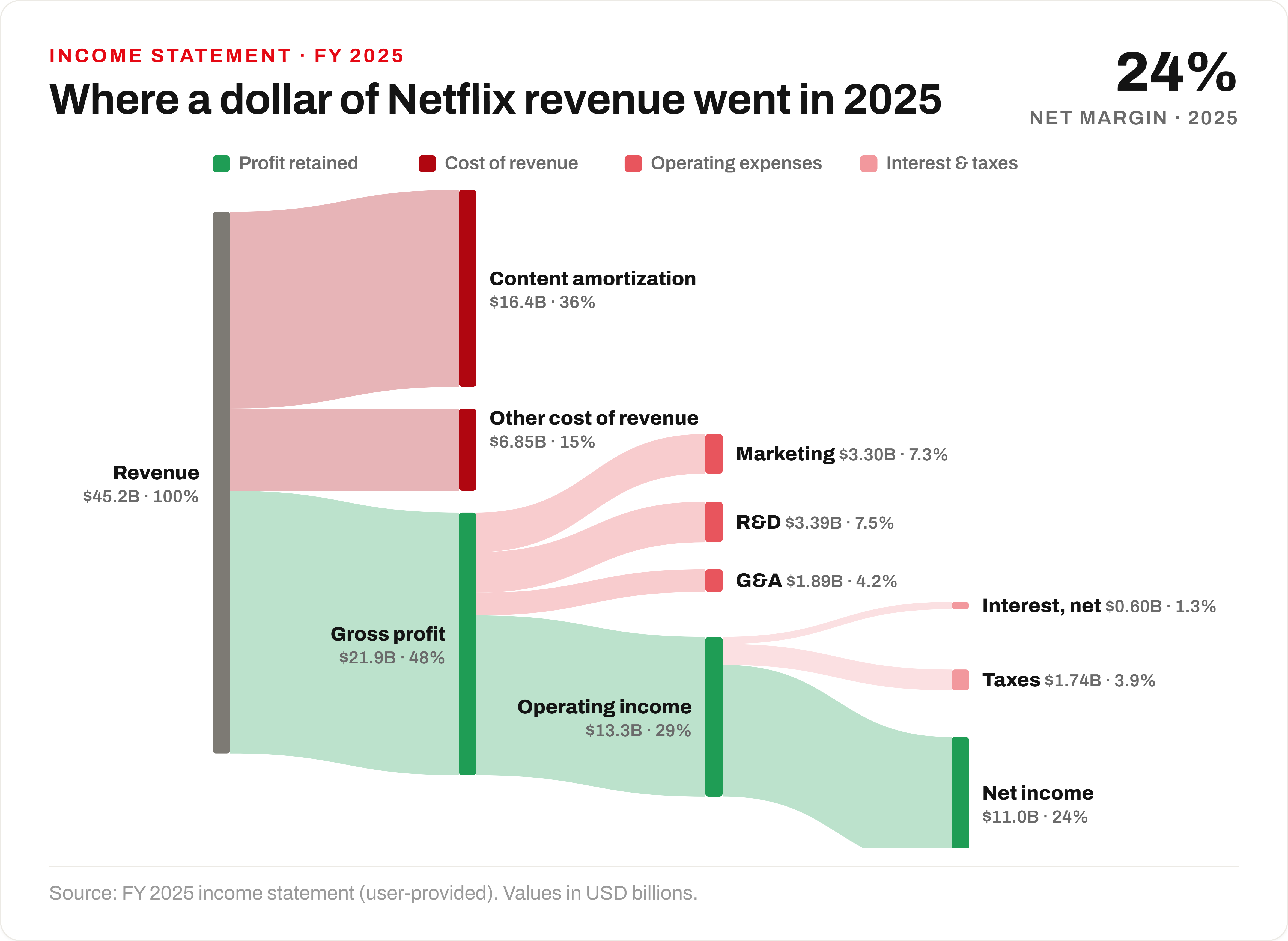
Here’s a quick description of all the categories (the first two are the only interesting ones):
Content Amortization captures the content costs smoothed over the expected viewing window. When Netflix pays for the licensing rights to air Suits for the next 5 years, they take the licensing cost number and divide over five years.
Other cost of revenue covers the costs associated with landing those licensing contracts, actor residuals, cloud computing costs directly associated with airing content, and other miscellaneous expenses like credit card transaction fees.
Marketing is self explanatory. This covers advertising, revenue sharing for bundling a subscription through your cell phone provider, etc.
R&D captures software engineering, computing hardware depreciation, and AWS expenses.
G&A captures all the overhead for running the business (HR & executive personnel costs, etc).
The chart below breaks down Netflix’s content strategy - they’ve consistently stayed in the low $70 per year range per member. So if the average user pays $11 per month, roughly $6 of that goes towards content and delivery.
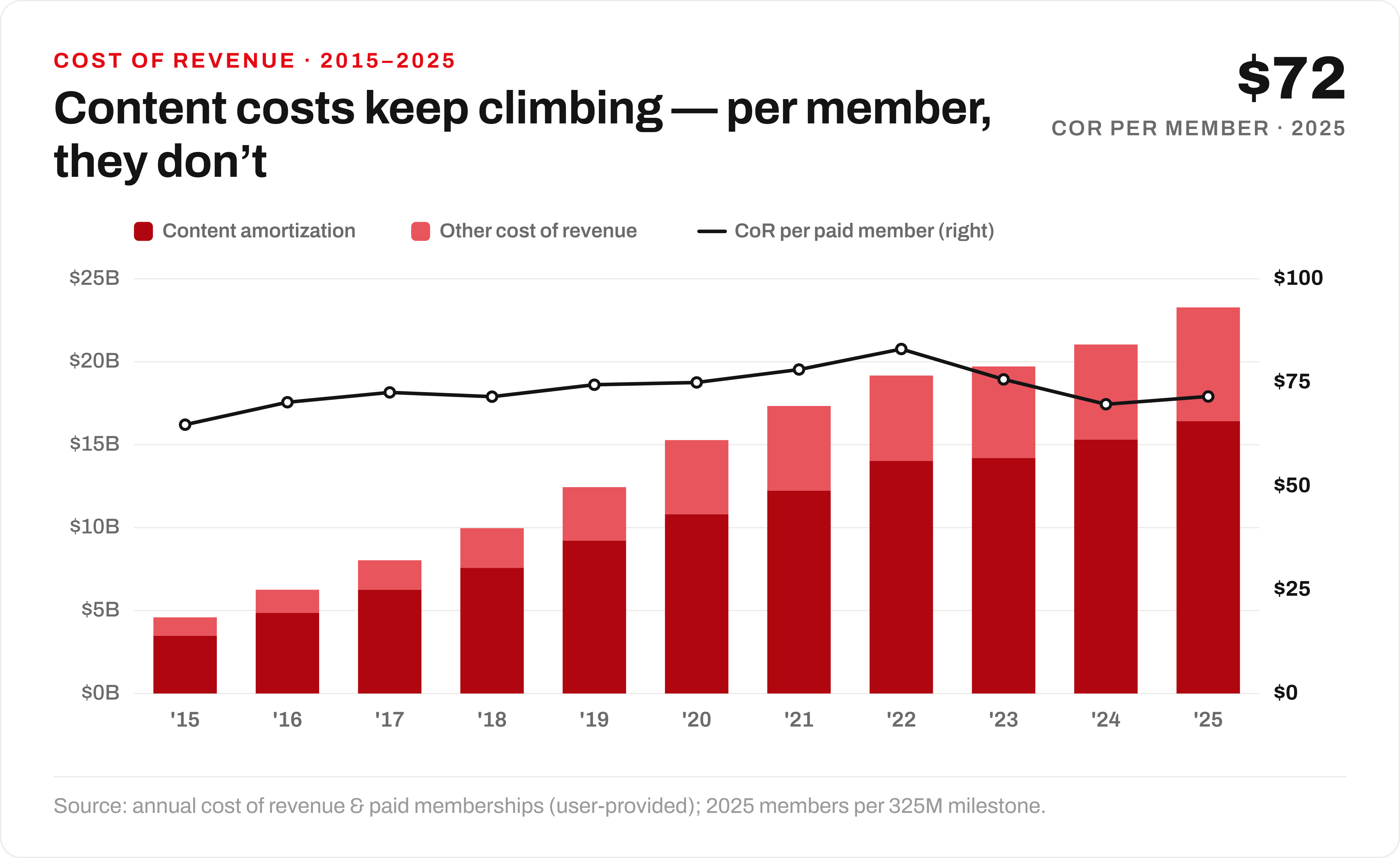
The question becomes will they continue growing their content budget even in the face of stagnating customer growth? Or will they try to maintain their current per-user spend? These are important drivers for the valuation, so we’ll need to consider these assumptions with care.
Strategic Investments
The final step before we can land on a valuation methodology is to look at investing cash flows to get a feel for their acquisition and capex strategies to see if we need to build out cash flow statements directly or if it’s okay to work directly from the income statement with smoothed expenses.
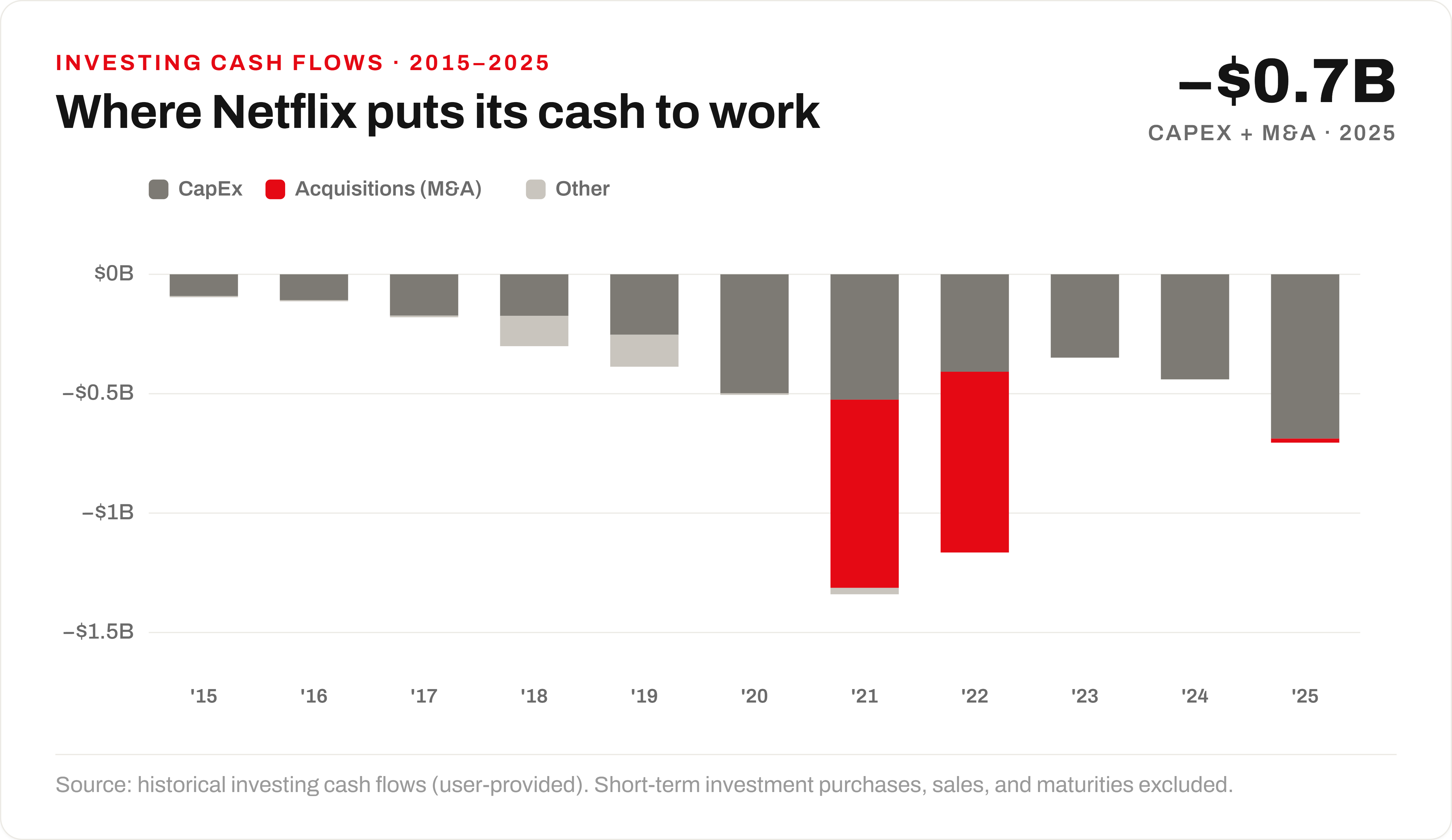
The two big acquisitions in ‘21 and ‘22 were buying the Roald Dahl Story Company (owner of the rights and trademarks for many classics like Charlie and the Chocolate Factory and Matilda among others) and Animal Logic, an animation studio. A good chunk of their capex budget since 2020 has gone to construction of their own production studios.
Based on this information - capex has been around $500M per year while depreciation sits roughly in-line at $300M per year - I think it’s fine to use the smoothed earnings as a close proxy for net cash flows. If they were to increase the cadence of acquisitions or expand their production business, we may have to revisit. But for now, net income should be fine.
Investment Thesis
The read here is simple. Netflix becomes cable, and is then able to charge ripoff pricing to customers using all the tricks of the industry trade, namely bundling, ads, etc. If so, what could its economic model look like?
Let’s start with pricing power. Netflix will assuredly be able to raise prices by 2-3% annually without customer backlash, as demonstrated by how cable companies have operated for decades. That should be a straight path towards consistent 10% EPS growth, considering the operating leverage within its business model. Add in returns from a growing ad business, as well as continued viewership growth. We could be talking about 15% EPS growth going forward from here.
At 26x PE, we start with an initial yield of 3.85%. Adding up the cumulative yield over time and assuming 15% EPS growth, we get to a breakeven point of 12 years, and a doubling of the initial investment by year 16. By year 20, your investment would have yielded nearly 4x the initial amount.
Furthermore, the visibility of earnings growth from here is solid. This isn’t a case where the business could suddenly disappoint to the downside in a significant way; Netflix is the largest company in the world in its sector, and it’s unlikely to be dethroned by its peers, whether that’s Disney or Comcast. Furthermore, there’s plenty of growth to be tapped in international markets, and we can trust that management knows what it’s doing to encourage viewership per hour further.
Performing a reverse DCF as a sanity check, to justify a 26x multiple, all we have to see is 4% long-term earnings growth to make today’s price a fair value. We’ve already shown that 4% revenue growth is an easy task at this stage for Netflix. Again, operating leverage should easily lift earnings growth above and beyond that.
In short, could Netflix be a wonderful business at a fair price? At 26x PE, it certainly isn’t deep-value; but for a business that may see double digit EPS growth for the foreseeable future, and with many growth levers remaining to be pulled, the price certainly seems fair enough. This reminds me somewhat of when Buffett bought Coke in 1988, when he was looking at how per capita sugar consumption internationally still paled in comparison to those in the US, and the pricing power lying latent behind the Coke product.
 | A guest post by
|